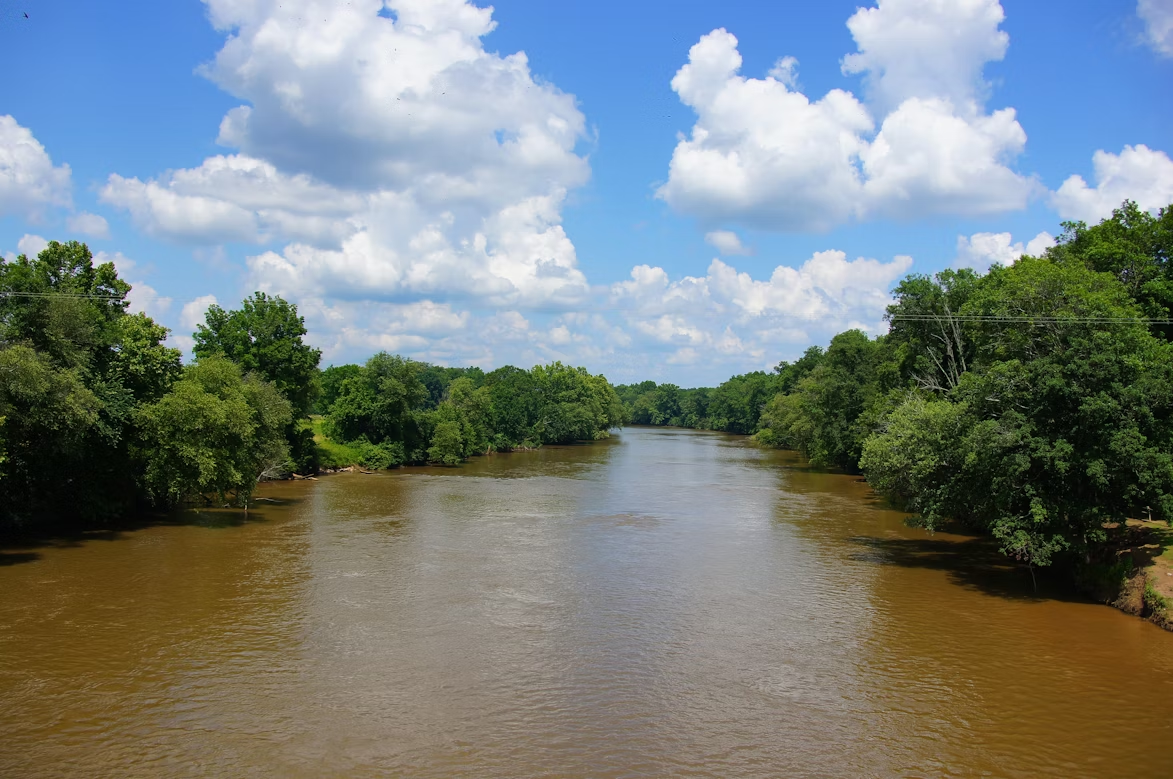
Atlanta occupies an unusual position in US water quality: its water is naturally soft (low mineral content, no hardness problems), generally free from industrial contamination, and meets all federal standards. Yet by the measure that matters most to independent health researchers — disinfection byproduct (DBP) levels — Atlanta consistently ranks among the most concerning major US cities.
The issue is the Chattahoochee River.
Where Atlanta's Water Comes From
The city of Atlanta's water — distributed by the Atlanta Department of Watershed Management — is drawn from the Chattahoochee River and Lanier reservoir. The Chattahoochee is a warm-water river flowing through the Southern Piedmont's organic-rich watershed, carrying substantial amounts of natural organic matter (decaying plant material, humic acids, and related compounds) year-round.
This matters because disinfection byproducts form when chlorine — added at water treatment plants to kill pathogens — reacts with the organic matter in source water. More organic matter in the source water + chlorine disinfection = more DBPs in your tap.
The Chattahoochee is not a uniquely polluted river. Its organic content is natural. But that natural profile, combined with conventional chlorine disinfection, produces DBP levels that consistently exceed EWG health guidelines — in some cases by very large margins.
What's in Atlanta Tap Water in 2026
Disinfection Byproducts — The Primary Concern
Total Trihalomethanes (TTHMs): Formed when chlorine reacts with organic compounds in water. The group includes chloroform, bromodichloromethane, dibromochloromethane, and bromoform. All four have been associated with increased cancer risk — bladder cancer most prominently — in epidemiological studies.
Atlanta's TTHM levels have ranged from 18–85 ppb in monitoring data, with averages around 60–65 ppb. The federal MCL is 80 ppb (averaged over a year and across sampling locations). Atlanta's average is below the legal limit — but the upper range can exceed it in some locations and seasons, and even the average is 400x higher than EWG's health guideline of 0.15 ppb.
Haloacetic Acids (HAA5 and HAA9): Another family of DBPs formed during chlorine disinfection. HAA5 (the five regulated haloacetic acids) has been detected in Atlanta water at 24–56 ppb range, against the federal MCL of 60 ppb. The expanded HAA9 group (which includes additional bromine-containing species) has been measured at levels hundreds of times above EWG's health guideline.
What the EWG comparison means: EWG's health guidelines are set at a "one in one million lifetime cancer risk" level — an extremely conservative threshold. When they say Atlanta's HAA9 is 905x their guideline, that means the level is far above what would be needed to eliminate essentially all statistical cancer risk from lifetime exposure. It does not mean Atlanta residents are acutely poisoned. The actual excess risk from drinking Atlanta water as measured is small — but real, particularly for cumulative lifetime exposure.
The brominated DBP issue: The Chattahoochee, like many Southern rivers, has elevated bromide from geological and agricultural sources. When water with elevated bromide is chlorinated, it forms brominated DBPs (bromodichloromethane, dibromochloromethane, bromoform) preferentially over simpler chlorinated species. Brominated DBPs are generally considered more potent carcinogens than their chlorinated counterparts. A major study published in Environmental Science & Technology in late 2025 specifically identified bromide-elevated water supplies as requiring more aggressive DBP management approaches.
Chromium-6: Present, Above EWG Guideline
EWG data shows chromium-6 at detectable levels in Atlanta water, above California's 0.02 ppb health goal. The source is likely geological — the Piedmont bedrock contains chromium-bearing minerals. Levels are far below any enforceable standard (federal total chromium MCL is 100 ppb; California's new specific chromium-6 MCL is 10 ppb), and below EWG's measurement thresholds in many testing periods.
Not a primary concern, but adds to the DBP-reduction argument for RO filtration.
Lead: Concern in Older Homes
Atlanta's distribution system itself isn't the primary lead problem — the treated water leaving the plants has very low lead. The risk, as in most cities, is from service lines and interior plumbing in older homes.
Atlanta has some old housing stock — significant portions of Inman Park, Grant Park, Virginia-Highland, Candler Park, and other historic neighborhoods predate 1986, meaning lead solder at pipe joints. The Atlanta Department of Watershed Management has programs for lead testing (contact (404) 546-0311).
If you live in a pre-1986 home in Atlanta, lead should be considered alongside DBPs when choosing filtration.
Hardness: Low — Not a Problem
Atlanta's water is soft: TDS around 45–60 ppm, hardness typically below 5 GPG. This is the one area where Atlanta clearly wins compared to Phoenix, Las Vegas, or Colorado Springs. No scale formation, excellent soap lathering, no appliance damage from minerals. Residents don't need water softeners.
The DBP Exposure Pathways Most People Miss
DBPs in drinking water are a concern through ingestion — but trihalomethanes are volatile (they evaporate easily from water), which creates two additional exposure routes:
Hot showers: When shower water is hot, TTHMs and some HAAs volatilize into steam, which is then inhaled. Research has documented that inhalation exposure to THMs during showering can equal or exceed ingestion exposure. This doesn't mean a shower causes acute harm; it means that if you're filtering drinking water but not showering in filtered water, you're still being exposed.
Dermal absorption: Some DBPs are absorbed through skin during bathing and showering, though this pathway is less significant than inhalation for volatile compounds.
Practical implication: For people who are most concerned about DBPs (pregnant women, households with young children, people with elevated cancer risk), a whole-house carbon filter — which reduces TTHMs and HAAs throughout the house — provides more comprehensive protection than a kitchen-tap filter alone. For most people, however, a kitchen RO or high-quality carbon filter for drinking and cooking water is a proportionate, practical step.
→ Check your specific Atlanta neighborhood's water quality data at PureCity
Filter Recommendations for Atlanta
The primary goal in Atlanta is DBP (TTHM + HAA) reduction. Activated carbon — especially higher-quality carbon filters — is effective against TTHMs. For comprehensive DBP reduction including HAAs plus any other concerns (lead, chromium-6), reverse osmosis is the most thorough option.
Under-sink RO — best comprehensive protection:
- APEC ROES-50 (~$215) — NSF 58 certified; removes TTHMs, HAAs, chromium-6, lead, and a broad spectrum of contaminants
- iSpring RCC7AK (~$219) — adds remineralization; since Atlanta water is already soft, RO-produced water can taste very flat; the remineralization stage improves it significantly
Under-sink carbon filter (for DBPs specifically, no RO):
- Frizzlife SK99 (~$90) — NSF 53 certified, high-quality catalytic carbon block; strong DBP reduction at lower cost than RO; does not remove chromium-6 or lead as comprehensively
Best pitcher for renters:
- Clearly Filtered Pitcher (~$90) — certified for a broad range of contaminants including DBPs and lead; best non-RO pitcher available
Shower filter (if DBP inhalation is a concern): A vitamin C/ascorbic acid shower filter neutralizes chlorine and reduces volatilization of some DBPs in shower steam. These are inexpensive ($20–$40) and require no plumbing. Note: they work for chlorine removal but provide less comprehensive DBP reduction than a full carbon block. If you have Atlanta's older water — heavily organic-loaded Chattahoochee source water — a shower filter is a low-cost supplemental step.
Pre-1986 homes — add NSF 53 lead certification: If you're in an older Atlanta home, make sure your filter is specifically NSF 53 certified for lead, not just NSF 42 (taste/odor only).
What Atlanta Is Doing About DBPs
The Atlanta Department of Watershed Management is aware of the DBP issue. Treatment options utilities use to reduce DBPs include:
- Moving disinfection later in the treatment process (after more organic matter has been removed)
- Ozonation or UV treatment to reduce organic precursors before chlorination
- Enhanced coagulation to remove organic material
- Switching to chloramine (which produces less TTHMs, though more of some other DBPs)
Atlanta uses conventional chlorine disinfection. A full switch to chloramine or adding ozonation would reduce TTHMs substantially — the trade-off is higher nitrosamine DBP formation with chloramine. These are infrastructure decisions that utilities make over years and decades.
In the meantime, treatment at the tap is the practical path for residents.
The Bottom Line for Atlanta Residents
Atlanta water is soft and federally compliant, which is a genuine advantage. The real issue is disinfection byproducts — specifically the brominated TTHMs and HAAs that form when chlorine meets the organic-rich Chattahoochee. These are the reason Atlanta appears prominently in EWG water quality comparisons.
For most residents, a quality carbon filter or RO system at the kitchen tap addresses the primary concern. Older home residents should confirm their filter has NSF 53 lead certification. People with heightened DBP concerns (pregnant, young children, elevated cancer risk) may want to consider whole-house carbon filtration to also reduce inhalation exposure during showering.
Related Articles
- Chloramine in Drinking Water: What Standard Carbon Filters Miss
- Chromium-6 in Drinking Water: The 'Erin Brockovich Chemical' With No Federal Limit
- Best Water Filter for Older Homes: Lead Solder, Galvanized Pipes, and What to Buy
Sources: EWG Tap Water Database: Atlanta · Atlanta Department of Watershed Management Annual Report · Hydroviv: Atlanta Water Quality Report · Environmental Science & Technology: Management of Disinfection Byproducts in Drinking Water, 2025 · EPA Disinfection Byproducts Rule · NSF Certified Products Database