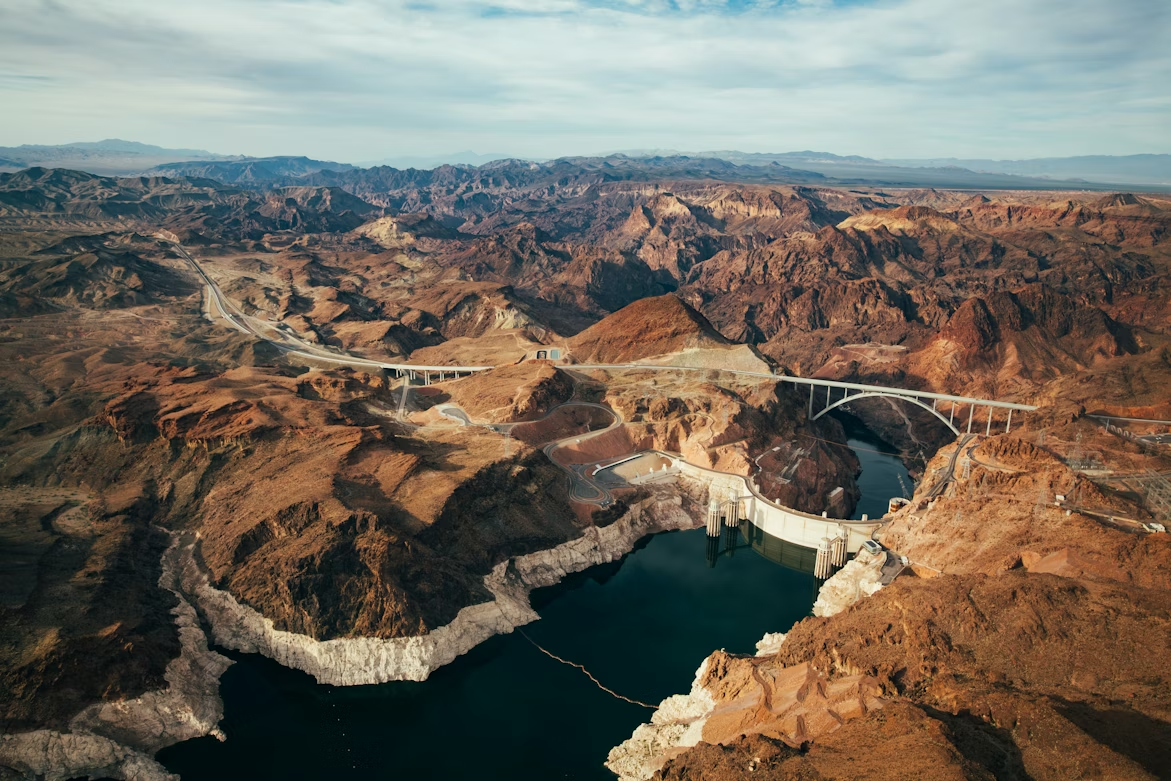
Las Vegas has a water paradox: it's one of the most water-stressed cities in America, drawing 90% of its supply from a shrinking Colorado River, yet it runs one of the most technically sophisticated water systems in the country. The Southern Nevada Water Authority (SNWA) is legitimately a global leader in water conservation — per capita use has dropped from 314 gallons per day in 2002 to about 140 gallons in 2024, even as the metro area added nearly a million people.
The water is also genuinely clean by regulatory standards. PFAS are below detectable limits. No active lead crisis. No boil-water advisories.
But Las Vegas tap water has a problem that shows up in every fixture and appliance in the house: it is extremely hard. And it uses chloramine as a disinfectant, which most carbon filters don't remove effectively.
Here's the complete picture.
Where Las Vegas Water Comes From
About 90% of Southern Nevada's municipal water is drawn from Lake Mead — the reservoir formed by Hoover Dam on the Colorado River, fed by Rocky Mountain snowpack. The remaining 10% comes from groundwater aquifers beneath the Las Vegas Valley.
The Colorado River problem: Lake Mead has been at historically low levels since the early 2000s drought cycle. As of 2025, Nevada is operating under Tier 1 shortage conditions with a 21,000 acre-feet reduction (about 7% of Nevada's allocation). SNWA's "Water Resource Plan 2025–2075" models strategies for extreme climate scenarios including potential participation in California coastal desalination.
The hardness comes directly from the geology of the Colorado River watershed. Water flowing through the limestone and mineral-rich geology of the Southwest accumulates calcium and magnesium. By the time it reaches Las Vegas, hardness runs 16–18 GPG (272–308 PPM) — among the highest of any major US city.
What's in Las Vegas Tap Water in 2026
Hardness: 16–18 GPG — Very Hard
This is the defining characteristic of Las Vegas water and the primary driver of resident complaints. Hardness at this level:
- Leaves white scale on faucets, showerheads, and fixtures within days of cleaning
- Deposits calcium scale inside water heaters, reducing efficiency by 30–50%
- Creates permanent filming on glass shower doors
- Reduces dishwasher performance and lifespan
- Reduces soap and shampoo lathering efficiency
- Produces the characteristic "mineral-heavy" taste that many Vegas residents find unpleasant
The SNWA's own water tasters note the dominant characteristics of Vegas tap water are chlorine aroma and a "dusty" or "mineral" quality — both consistent with the hardness profile.
For comparison: Phoenix is 18–19 GPG (slightly harder). Denver is 7–9 GPG. New York City is 1–3 GPG. Most US cities fall in the 7–12 GPG range.
Disinfection: Chloramine — Not Chlorine
Las Vegas uses chloramine (chlorine + ammonia) rather than free chlorine as its distribution disinfectant. This is common in large Western cities — Denver, Phoenix, Houston, and many others also use chloramine.
Chloramine matters for filtration because standard activated carbon filters (Brita, most pitcher filters, most faucet mounts) do not effectively remove chloramine. Chloramine requires either catalytic carbon (which decomposes chloramine) or reverse osmosis.
If you're running a standard carbon pitcher thinking it's improving your water quality, it's improving taste somewhat but not removing chloramine residual.
See: Chloramine in Drinking Water: What Standard Carbon Filters Miss
PFAS: Below Detectable Limits
The Southern Nevada Water Authority has been testing for PFAS since before federal requirements, and recent monitoring (2023–2025) shows PFAS compounds consistently below detection limits in finished water. Nevada's comprehensive UCMR 5 monitoring continues through 2026.
The nuance: Las Vegas Wash — the outflow channel that carries wastewater effluent back to Lake Mead (which SNWA then reclaims as part of its recycled water system) — does carry PFAS from wastewater sources. Academic research from the Frontiers journal (published January 2026) has mapped PFAS sources in the Las Vegas Wash, including wastewater treatment facilities and stormwater near Harry Reid International Airport. The SNWA's treatment processes remove PFAS before distribution; the concern is whether those processes remain effective as PFAS loads potentially increase.
Current assessment: No action required based on current monitoring. PFAS are below detection limits in distributed water.
Disinfection Byproducts: Within Limits but Present
Because Las Vegas water has high organic content from the Colorado River basin and requires significant disinfection treatment, trihalomethanes (TTHMs) and haloacetic acids (HAA5s) are present. SNWA testing shows these within federal MCLs but at measurable levels. The SNWA uses ozone treatment at its facilities partly to reduce organic precursors before chloramine addition.
Radium, Arsenic, and Other Minerals
Las Vegas water contains trace levels of radium and arsenic, both from the natural geology of the Colorado River watershed. SNWA testing shows these below EPA MCLs. The arsenic is natural origin (not industrial contamination) and at a much lower level than Phoenix (where it runs up to 8 ppb). Radium-226+228 has historically appeared at detectable but sub-MCL levels in some SNWA monitoring.
Lead: Low Concern
Las Vegas infrastructure is predominantly post-1980 copper and newer materials. The 90th percentile lead level in recent SNWA monitoring has been well below the federal action level of 15 ppb. Lead in Las Vegas tap water is generally not a primary concern compared to cities like Chicago, Milwaukee, or Newark.
→ Check your specific ZIP code's water quality data at PureCity
The Two Main Problems Las Vegas Residents Should Solve
Problem 1: Hard Water Damage to Appliances and Fixtures
At 16–18 GPG, unaddressed hard water will noticeably shorten the lifespan of water heaters, dishwashers, and washing machines, and will create constant maintenance work on fixtures and glass surfaces.
The solution: A whole-house ion exchange water softener. For a typical Vegas household at 17 GPG with 4 people using ~80 gallons/day each, a 40,000-grain capacity softener is appropriate.
A properly sized softener eliminates scale formation throughout the house, improves soap lathering, and extends appliance life. The tradeoff: monthly salt purchases (~$15–$30/month), and softened water has added sodium (~280 mg/L at typical Vegas hardness — relevant if you're on a very low-sodium diet).
Nevada does not restrict salt-based softeners (unlike some California counties).
Salt-free alternative: If you rent, live in a condo, or prefer to avoid salt, a template-assisted crystallization (TAC) conditioner reduces scale formation without removing hardness minerals or adding sodium. It won't give you the "soft feel" of ion exchange but prevents the scale damage that's the real concern.
Problem 2: Drinking and Cooking Water Quality
Even with a whole-house softener, most Vegas residents want better drinking water. The softener adds sodium; the chloramine residual affects taste; and trace minerals and DBPs remain.
The solution: An under-sink RO system at the kitchen tap. RO removes chloramine (90%+ rejection), TTHMs, remaining minerals, sodium from softener, and trace arsenic/radium.
The combination of whole-house softener + kitchen RO is the standard recommendation from every Las Vegas water professional — and it's what most long-term Vegas homeowners eventually land on.
Filter Recommendations for Las Vegas
Under-sink RO for drinking water (the core recommendation):
- APEC ROES-50 (~$215) — NSF 58 certified, removes chloramine, minerals, TTHMs, trace arsenic; the most reliable budget RO
- iSpring RCC7AK (~$219) — adds remineralization stage to put back beneficial minerals at optimal levels after RO strips them; particularly good for Vegas where remineralizing to a pleasant level makes sense after stripping very hard water
- Waterdrop G3P600 (~$400) — tankless design, faster flow, smaller footprint; worth the upgrade if kitchen aesthetics matter
Countertop RO (renters, no-installation option):
- Bluevua RO100ROPOT-LITE Countertop RO (~$299) — NSF certified countertop RO; excellent for Vegas apartments where under-sink installation isn't practical
If you can't do RO — best pitcher filter for chloramine:
- Clearly Filtered Pitcher (~$90) — independently certified for chloramine, PFAS, and 360+ contaminants; significantly better chloramine reduction than standard carbon pitchers
- Standard Brita/PUR pitchers: these reduce chlorine taste but do NOT effectively remove chloramine; not recommended as a primary filter in Vegas without catalytic carbon
SNWA Conservation Programs Worth Using
SNWA runs some of the most generous water conservation rebate programs in the US:
- Water Smart Landscapes: $3 per square foot for replacing turf with desert-adapted plants — can be thousands of dollars for a typical yard
- Water Smart Appliances: Rebates on high-efficiency washers and dishwashers (details at snwa.com)
Residents can find their watering schedule and group assignment at lvvwd.com.
The Bottom Line for Vegas Residents
Las Vegas water is safe — clean by federal standards, no active contamination crisis, PFAS below detection limits. The real issues are:
- Extreme hardness (16–18 GPG) that silently destroys water heaters and appliances if unaddressed
- Chloramine disinfection that most basic carbon filters don't remove
- Taste — the mineral content and chloramine combine for a strong taste most residents find unpleasant
For homeowners: a whole-house softener + kitchen RO is the comprehensive solution. For renters or those who want to start with just drinking water: an RO system (under-sink or AquaTru countertop) at the kitchen tap solves the chloramine, taste, and trace contaminant concerns simultaneously.
Related Articles
- Hard Water: What It Actually Does to Your Home, Your Health, and Your Appliances
- Chloramine in Drinking Water: What Standard Carbon Filters Miss
- Phoenix, Arizona Water Quality 2026: Arsenic, Hard Water, and What Residents Should Filter
- Best Under-Sink Reverse Osmosis Systems
Sources: Southern Nevada Water Authority: Water Quality FAQs · SNWA Water Resource Plan 2025–2075 · Nevada PFAS page, NDEP · Frontiers in Environmental Chemistry: PFAS in Lake Mead, January 2026 · Clean Air and Water: Las Vegas Water Quality Report 2025 · EWG Tap Water Database: Southern Nevada Water Authority