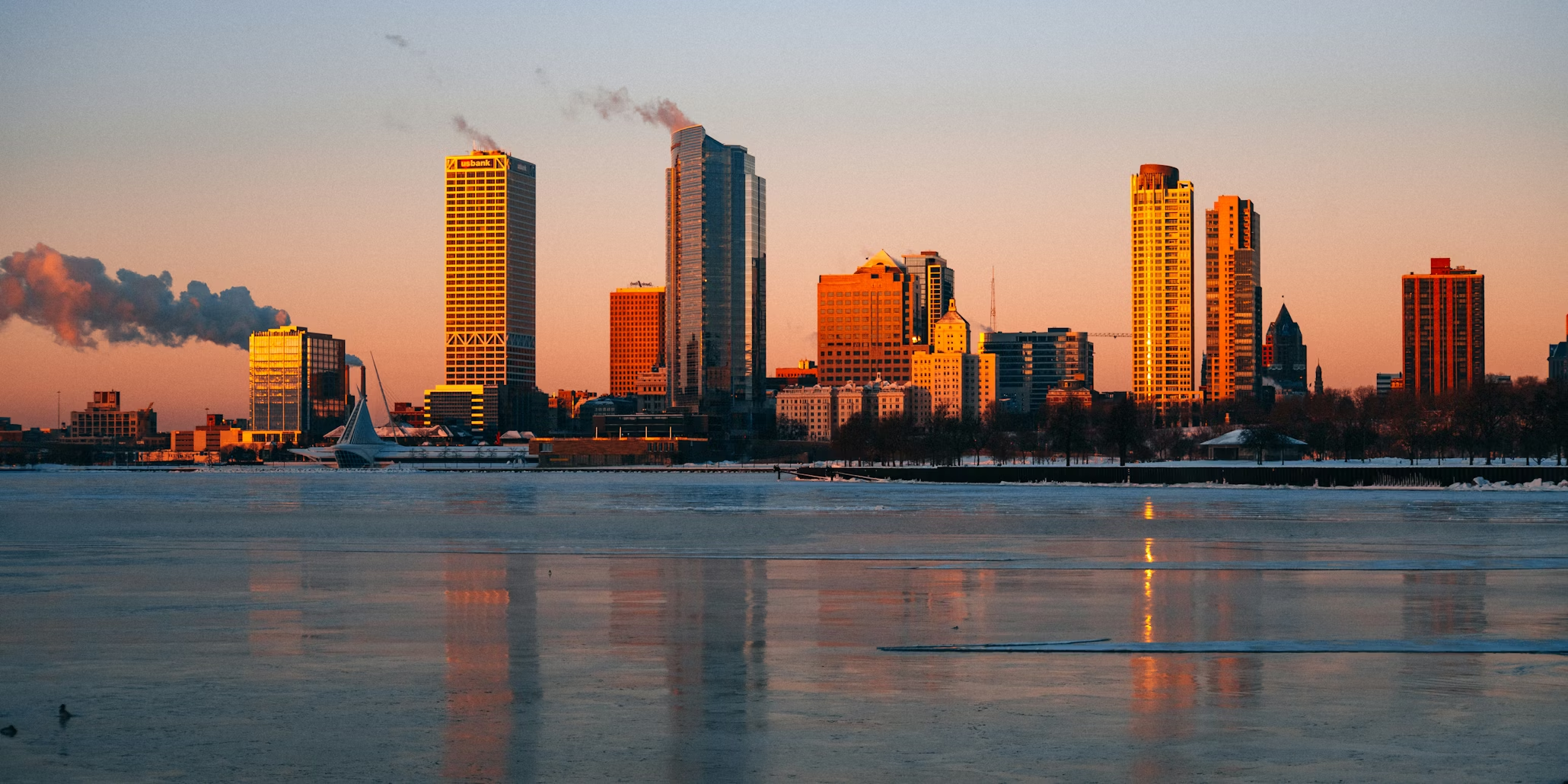
Milwaukee's water situation in 2026 is a study in contrasts: a water utility that consistently earns high marks for transparency and treatment quality, drawing from one of the world's great freshwater sources — but with 65,000 lead service lines still connecting older homes to the main, and a replacement timeline that will take years to complete.
On March 2, 2026 — just days before this article was written — Wisconsin Governor Tony Evers signed new state PFAS and lead regulations aligning Wisconsin's standards with federal rules. That's the most recent development in a story that's been building for years.
The Source Water: Lake Michigan
Milwaukee Water Works draws entirely from Lake Michigan, processing it at two facilities — the Linnwood Water Purification Plant on the north side and the Howard Avenue Water Purification Plant on the south. The treatment process is multi-step: ozone treatment (which kills pathogens and improves taste), coagulation, sedimentation, filtration, and disinfection with chloramine (not chlorine — an important distinction for filtration).
Lake Michigan is an excellent source. It is low in naturally occurring contaminants like arsenic or nitrates, relatively consistent in quality, and benefits from deep-water intakes that reduce biological contamination. The water leaving Milwaukee's treatment plants is genuinely high quality.
The University of Wisconsin–Madison's Wisconsin Waterworks Excellence Project gave Milwaukee Water Works top grades for health and transparency in its 2024 evaluation. The lower grade was in infrastructure and operations — reflecting the known challenge of aging pipes, including lead service lines.
The Lead Service Line Problem
Milwaukee has approximately 65,000 residential lead service lines — the pipes that run from the street main to individual homes. The city is replacing them, with priority given to neighborhoods where need is greatest based on lead pipe density, child health data, and community need.
The pace matters. Milwaukee Water Works sent updated service line material notification letters to affected properties in December 2025, as required by the federal Lead and Copper Rule Revisions. Wisconsin is now required under the new state law signed March 2, 2026 to complete lead service line replacement by 2037 — a deadline that provides a legal framework for the replacement pace.
What the current data shows: Milwaukee Water Works' 2023 Lead and Copper Rule compliance testing showed a 90th percentile lead level of 5.3 ppb — well below the EPA's 15 ppb action level, and considerably better than Chicago's comparable figure. Milwaukee uses a food-grade phosphorus compound for corrosion control, which coats the inside of pipes and reduces lead leaching. This is working — but it is not a substitute for replacement.
The first-draw risk. If your home has a lead service line and water has been sitting in the line overnight, the first draw from your tap in the morning will have higher lead concentrations than after running the water for several minutes. Milwaukee Water Works recommends running cold water for at least three minutes first thing in the morning if you have a lead service line. Use a glass to smell the water away from the sink first — if it smells fine away from the drain, it's likely the drain that smells, not the water.
How to check your address: Milwaukee Water Works maintains an address lookup tool at milwaukee.gov/water to check whether your property has a confirmed, likely, or unknown service line material. Free water testing is also available to any Milwaukee resident.
→ Enter your Milwaukee ZIP at PureCity to see lead risk data and water quality history for your neighborhood.
PFAS in Milwaukee Water
Milwaukee Water Works has been testing for PFAS since 2008 — an unusually long track record for a US utility. Current results are reassuring: in 2023, the two most common PFAS compounds (PFOA and PFOS) measured between 2 and 3.1 parts per trillion in Milwaukee's distribution system — well below Wisconsin's prior standard of 70 ppt and also below the new federal and state MCLs of 4 ppt.
The new Wisconsin regulations signed March 2, 2026 align state PFAS standards with EPA's 2024 federal rules: 4 ppt for PFOA and PFOS individually, 10 ppt for PFNA, PFHxS, and GenX. Milwaukee Water Works' current PFAS levels comfortably meet these standards.
That said, PFAS is a Lake Michigan-wide issue. The Great Lakes have been subject to PFAS contamination from industrial sources, firefighting foam, and consumer product runoff. Milwaukee benefits from deep-water intake cribs that draw from less-contaminated offshore water, but monitoring is ongoing. The $282 million in Wisconsin drinking water funding announced in November 2025 will support treatment upgrades across the state.
Chloramine — What It Means for Your Filtration
Milwaukee uses chloramine (chlorine + ammonia) rather than chlorine alone for final disinfection. This is common practice in many US cities and has advantages: chloramine is more stable in distribution systems and produces lower levels of some disinfection byproducts (particularly trihalomethanes) than free chlorine.
However, chloramine requires different filtration:
- Standard activated carbon filters are less effective at removing chloramine than chlorine
- Catalytic carbon (a modified form of activated carbon) is specifically designed for chloramine removal
- Most standard pitcher filters (basic Brita, PUR Standard) are not optimized for chloramine
- NSF 42 certification covers chlorine taste and odor, but not necessarily chloramine
If you're filtering Milwaukee water specifically for taste and odor, look for a filter that specifies chloramine reduction — or use a reverse osmosis system, which removes both.
What Filter Makes Sense in Milwaukee
Priority concern: lead (for homes with unreplaced service lines)
Any filter you use must be certified to NSF/ANSI Standard 53 for lead reduction. This is non-negotiable — NSF 42 or a generic carbon filter will not protect you against lead.
Best options:
- Frizzlife SK99 Under-Sink Filter (~$90) — NSF 53 certified, no drilling required, includes catalytic carbon stage that addresses chloramine
- Clearly Filtered Pitcher (~$90) — certified for lead, PFAS, chloramine, and 360+ contaminants; best non-RO pitcher option for Milwaukee's specific water profile
- APEC ROES-50 Under-Sink RO (~$215) — removes lead, PFAS, disinfection byproducts, and virtually everything else
- Bluevua RO100ROPOT-LITE Countertop RO (~$299) — installation-free option for renters
If your service line has already been replaced: Lead risk from the service line is eliminated. You may still want to filter for taste (chloramine) or as a precaution against PFAS and interior plumbing lead (older fixtures, pre-1986 solder). A catalytic carbon under-sink filter or RO unit covers both.
The 2037 Replacement Deadline
Wisconsin's new law requiring lead service line replacement by 2037 gives Milwaukee 11 years to complete the remaining ~65,000 replacements. That's roughly 6,000 per year — an aggressive but achievable pace if funding holds.
In the meantime, checking whether your specific address has a lead service line and using a certified filter at your kitchen tap is the most practical step for Milwaukee residents who haven't yet been through the replacement program.
Free resources from Milwaukee Water Works:
- Address lookup: milwaukee.gov/water/LeadPipes
- Free water testing: available to all Milwaukee residents
- Prioritization program updates: city.milwaukee.gov/water
Related Articles
- Does Your Water Filter Actually Remove Lead? What Brita Won't Tell You
- Chicago Water Quality 2026: The Lead Pipe Problem Most Residents Don't Know About
- PFAS in Drinking Water: What It Is, Where It's Found, and How to Filter It
Sources: Milwaukee Water Works · Milwaukee Water Works 2024 Annual Water Quality Report · Milwaukee Lead Pipes Overview · Wisconsin Gov. Evers Signs New PFAS and Lead Regulations, March 2, 2026 · Wisconsin PFAS Contamination, FOX6 Milwaukee · NSF Certified Products Database